For as long as basketball has been played, we’ve debated greatness with rings, MVPs, highlight reels and stats. But what if we could put a dollar figure on a player’s statistical production? Not their contract, not their endorsements — but the raw, on-court value they generate.
That’s the idea behind Financial RealVPM (Value Per Minute).
RealVPM (Real Value Per Minute) measures the statistical value a player generates every minute they’re on the floor. It combines both offense (ATT) and defense (DEF) into a single measure of total impact.
With Financial RealVPM we aim to translate that into dollar value using the league’s median salary as a benchmark.
We can use this to gives us a dollar-per-game and dollar-per-season estimate of how much statistical value a player creates.
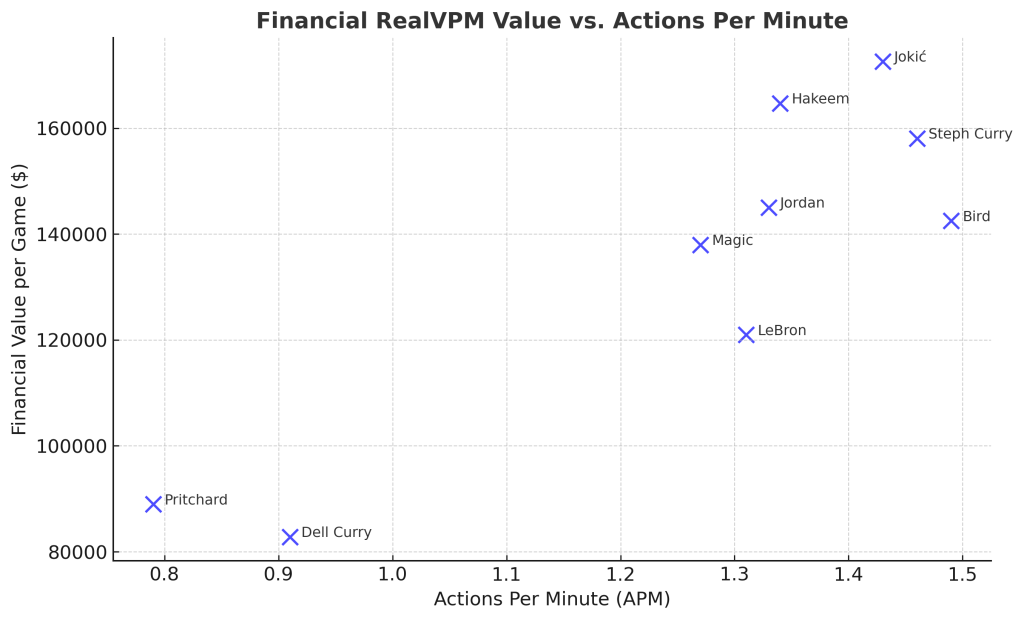
Adding Actions Per Minute (APM)
Not all value looks the same. Some players dominate by sheer volume of activity, while others generate elite value with fewer actions. That’s where Actions Per Minute (APM) comes in — a measure of how often a player attempts a value-generating action per minute (shot, rebound, assist, steal, etc.).
Together, Financial RealVPM + APM tell us both how much value a player produces and how they produce it — by volume, efficiency, or a balance of both.
We took a look at the careers of some past and present greats, as well as, two important role players who both own Sixth Men of the Year Awards.
Profiles of Greatness
Michael Jordan – Balanced Brilliance
Jordan sits at $144,990 per game, backed by a strong 1.33 APM. He combined high activity with elite efficiency, dominating possessions without wasting them.
Larry Bird – Activity Overload
At 1.49 APM, Bird was involved in nearly everything that happened when he was on the floor. His dollar value nearly matches Jordan’s, but he reached it through extreme involvement.
Magic Johnson – The Efficient Orchestrator
Magic’s APM of 1.27 is lower than Bird or Jordan, but his financial value per game ($137,960) shows that when he acted, it counted. His brilliance wasn’t volume — it was efficiency.
Hakeem Olajuwon – The Two-Way Anchor
At $164,700 per game, Hakeem towers as one of the most statistically valuable players in modern NBA history. His APM of 1.34 reflects a steady stream of defensive and offensive actions that made him the centerpiece of Houston’s success.
LeBron James – Longevity and Versatility
LeBron’s $120,983 per game may look modest compared to Jokić or Curry, but spread across two decades, it represents unparalleled consistency. His 1.31 APM reflects a balanced, adaptable style — sometimes high activity, sometimes selective dominance.
Stephen Curry – The Hyper-Active Sharpshooter
Curry generates $158,058 per game at a blistering 1.46 APM. Few players in history have combined such volume with such efficiency, reshaping the game around the three-point line.
Nikola Jokić – The Ultra-Efficient Hub
Jokić tops the table with $172,601 per game with one of the lowest minutes per game. His 1.43 APM shows constant involvement, but what sets him apart is his ability to generate elite value without extended minutes — efficiency on steroids.
The Role Players – Pritchard and Dell Curry
Both 6th Man of the Year winners in their respective eras, their values ($88,940 and $82,792) reflect important contributions off the bench. With lower APM, their roles weren’t about constant involvement, but timely bursts of value.
Why It Matters
Financial RealVPM + APM reframes greatness:
- Bird and Curry dominated through activity and volume.
- Magic and LeBron relied on precision and efficiency.
- Jordan, Hakeem, and Jokić balanced both — overwhelming involvement with elite efficiency.
- Role players show that even modest APM and dollar values have real statistical worth.
The Future of Player Valuation
This model is only the beginning. Future refinements might:
- Adjust for pace of play (faster eras naturally inflate number of actions).
- Add playoff weighting where value is amplified.
- Incorporate longevity curves, measuring how value changes over careers.
Conclusion
Financial RealVPM doesn’t capture everything — not leadership, not ticket sales, not cultural impact. But it offers a fresh, dollar-based way to compare players across eras.
From Jordan’s balanced dominance to Jokić’s modern efficiency, from Curry’s hyperactivity to Magic’s orchestration, this model shows there are many ways to create value.
In the end, greatness isn’t just about rings or stats. Sometimes, it’s about how much your game is worth.